
What Really Drives Stock Prices?Supply, Demand, and Market Sentiment
- Editor

- Dec 15, 2025
- 4 min read
Indian stock markets often confuse even experienced investors. Companies report strong profits, yet their stock prices fall. Others show modest performance, but their stocks rally sharply. While this may appear irrational, stock price movements in India follow a clear underlying logic.
At the heart of every price movement are three forces: supply, demand, and market sentiment. Financial fundamentals matter, but prices are ultimately driven by how investors collectively respond to information, expectations, and emotions.
The Stock Market Is a Marketplace Before It Is a Valuation Exercise
Every stock price on the NSE or BSE is created by a transaction a buyer willing to pay a certain price and a seller willing to accept it. No valuation model, target price, or analyst report can move a stock unless it changes this buying and selling behaviour.
When demand for a stock exceeds the number of shares available for sale, prices rise. When selling pressure dominates, prices fall. This basic supply–demand mechanism explains all short-term price movements, regardless of company quality.
Supply & Demand in Stock Markets

These visuals clearly show how prices adjust as buyer and seller intensity changes.
Why Expectations Drive Demand More Than Results
One of the most important lessons in investing is that markets react to expectations, not absolute numbers.
In India, this is clearly visible during earnings seasons. A company may report profit growth, yet its stock declines because investors expected better results or stronger future guidance. Conversely, a stock may rise despite weak current earnings if future prospects improve.
This dynamic explains why IT stocks in 2023 showed muted performance despite stable revenues global slowdown concerns reduced growth expectations. Meanwhile, PSU stocks rallied sharply as expectations around governance, profitability, and capital efficiency improved.
Earnings Surprise & Price Reaction

These explain how changes in expectations lead to sharp price movements even when results look “good on paper.”
Supply Constraints and the Indian PSU Rally
Supply is often overlooked, but it plays a critical role in Indian markets.
Many PSU stocks have high promoter ownership, meaning fewer shares are available for public trading. When domestic mutual funds and retail investors increased allocation to PSUs between 2020 and 2024, demand rose sharply while supply remained limited. This imbalance led to multi-year rallies across defence, railways, and energy PSUs.
Stocks with limited free float tend to move faster both upward and downward because even small changes in demand significantly affect prices.
Free Float vs Total Shares

These diagrams help explain why certain Indian stocks experience sharp volatility.
Market Sentiment: The Human Side of Indian Markets
If supply and demand are mechanical forces, sentiment is psychological. Market sentiment reflects how investors feel optimistic, confident, fearful, or uncertain.
The COVID-19 crash in India is a textbook example. Between February and March 2020, the NIFTY 50 fell nearly 40% in just a few weeks. This fall was not caused by immediate collapse in company fundamentals, but by panic, uncertainty, and global risk aversion.
As liquidity returned and confidence improved, many of the same stocks recovered strongly within the next 12–18 months.
Investor Psychology & Market Cycles

These visuals clearly show how emotions like fear and greed influence buying and selling decisions.
Retail Participation and Sentiment After 2020
Post-2020, India saw a surge in retail participation. Millions of new demat accounts were opened, and retail investors became a major force in driving momentum-based rallies.
Sectors like defence, railways, and renewables experienced sharp price increases, sometimes running ahead of earnings growth. This does not mean fundamentals were ignored, but rather that optimism and narratives boosted demand faster than profits grew.
Such phases highlight how sentiment can temporarily dominate fundamentals.
Interest Rates, Inflation, and Market Mood (2022 Correction)
In 2022, rising inflation and aggressive global interest rate hikes impacted Indian equities. Higher rates reduced risk appetite and changed how investors valued future earnings.
Even companies with stable revenues and strong balance sheets saw corrections. The decline reflected a shift in sentiment and required returns, not an immediate deterioration in business quality.
The Long Term: Where Fundamentals Reassert Control
While sentiment and flows dominate short-term price movements, Indian markets have consistently shown that fundamentals matter over time.
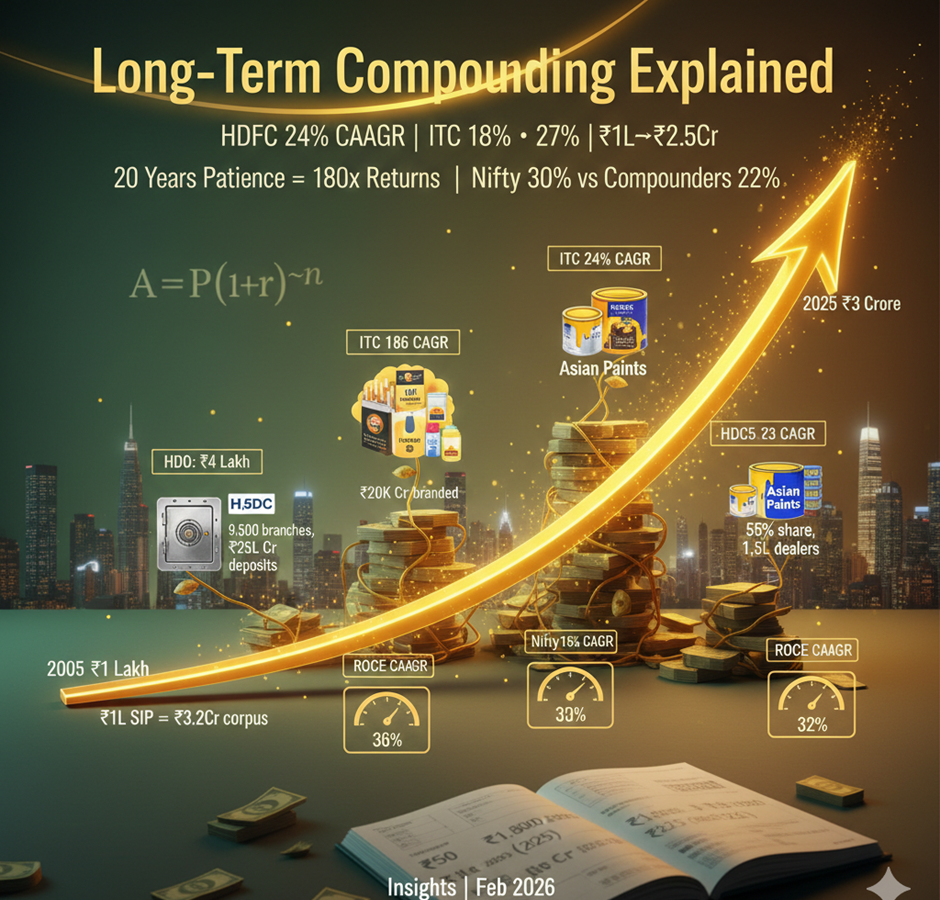
Companies that grow earnings sustainably, maintain healthy balance sheets, and allocate capital efficiently tend to recover from downturns and compound value in the long run. Short-term volatility reflects emotion; long-term trends reflect business performance.
Market Psychology vs Long-Term Trend

Conclusion
Indian stock prices are not driven by financial statements alone. They are shaped by supply limitations, changing demand, and investor sentiment all influenced by expectations about an uncertain future.
Understanding these forces helps investors interpret market movements more clearly, avoid emotional reactions, and develop a more realistic view of how prices actually move.
When you see the stock market as a human marketplace rather than a purely mathematical system, its behaviour begins to make far more sense.


Comments